Natural Selection - A story.
Now that we have heard several examples of natural selection in action (Darwin's finches, twitching lizards, elephants tusks, Galapagos Marine Iguanas) - you now must find an example of your own.
Do some research to an example of natural selection that is unique. Your job is to do a write-up similar to what you used for your elephant or iguana example. IF YOU FIND A UNIQUE EXAMPLE - YOU CAN EARN EXTRA CREDIT! (See example to the right)
Evolution in Action:
Natural Selection and Elephant Tusks
History: African Elephants have long been sought after by hunters that are illegally poaching large adults for the ivory in their tusks. Experts from the Wildlife Conservation Society believe that there are around 25,000 elephants poached each year despite a poaching ban that came in the 80s. In 1930, biologists noticed that about 1% of wild elephant populations were born with a “tuskless” allele and would not grow tusks during adulthood.
The Situation: Today, in some populations, 38% or more of African Elephants are born without tusks. Poachers are much less interested in the “tuskless” variety due to absence of the valuable ivory from the tusks.
The Question: Explain how NATURAL SELECTION would have caused this obvious change in the “tuskless” variety of elephants in Africa. In your response, include how elephants show variation, which trait is beneficial and why, and how the beneficial trait becomes common over time.

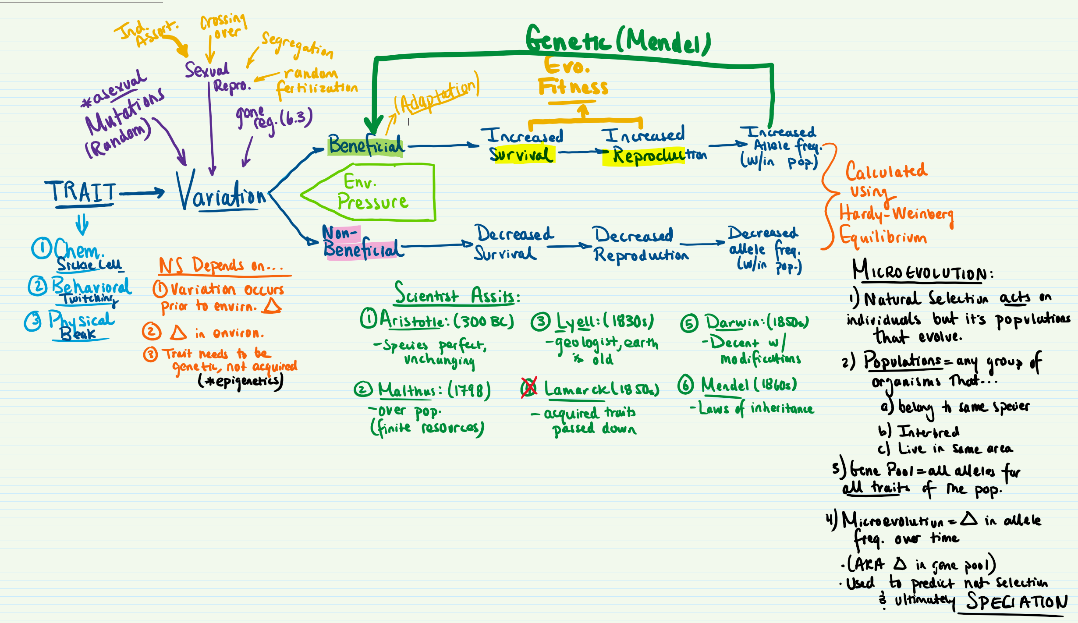
Lesson #1: Natural Selection "Flow-Chart" (from in class on 3/6)

Textbook Lesson(s):
Text Pages: 13.1-13.6
p. 255-263 (due Tuesday 3/11)

Vocab: evolution, fossils, artificial selection, natural selection, paleontology, fossil record, index fossil, biogeography, homology, homologous structures, vestigial structures, molecular biology, evolutionary tree

Video for Mini-Lab: Natural Selection in Action (WATCH CAREFULLY) - Complete in Class on 3/4
Look for....1) What specific trait is being studied? 2) What is the natural variation that exists within the Finches (for that trait) 3) What is the environmental pressure? How does the environmental pressure change? 4) What leads to either increased or decreased survival? 5) Does this trend last long term?
Viewed in class on 3/6: EVOLUTION IN A BIG CITY (Answer questions in unit guide (see page 2)
1) What were 3 organisms used in this study?
2) What are is the tool that scientists use today to determine relatedness of two organisms that Darwin never had?
3) What are three traits that were examined by comparing the "city" mice vs. the "country" mice? How might these traits be different?

Learning Targets:
1) I can explain the mechanisms of natural selection to determine how traits vary from population to population
2) I can explain how multiple fields of evidence support the modern theory of evolution.