1.1 - Scientific Investigation

Preview: 

- Please read the short article "What Science Wants to Know" 

- After reading, complete the GoogleForm (summarize this article using SEVEN words or less!) 

- Be prepared to discuss in class! 

- Please record your response in your notebook at home and then your UNIT GUIDE in class (will be handed out on 8/18). 

- Due end of the day (8/15) 

What Science Wants to Know.pdf What Science Wants to Know.pdf
Size : 79.823 Kb
Type : pdf

Lesson: 

Vocab: observation, question, hypothesis, experiment, data analysis, conclusion, inference, independent (manipulated) variable, dependent (responding variable), control group, experimental group, constants, qualitative data, quantitative data, conclusion

Text Pages: sections 1-1 through 1-7

p. 1-8 

Read by 8/20

H. Bio Text Ch.1.pdf H. Bio Text Ch.1.pdf
Size : 1913.122 Kb
Type : pdf

Video Lesson: Experimental Design  (Stay Tuned)

Assignment: 

DUE

Before class of 8/19

Reading scientific research is an ENTIRELY different form of reading/interpretation than what we're used to. The skill of reading research can be an incredibly  powerful tool for understanding scientific findings WITHOUT bias (especially with current events that news publications "summarize"). We will spend much of the year learning HOW to read scientific work. You CANNOT simply read like a casual novel. Take your time and I.D. important experimental design components as you go. By the end of the year, you will be a PRO! 

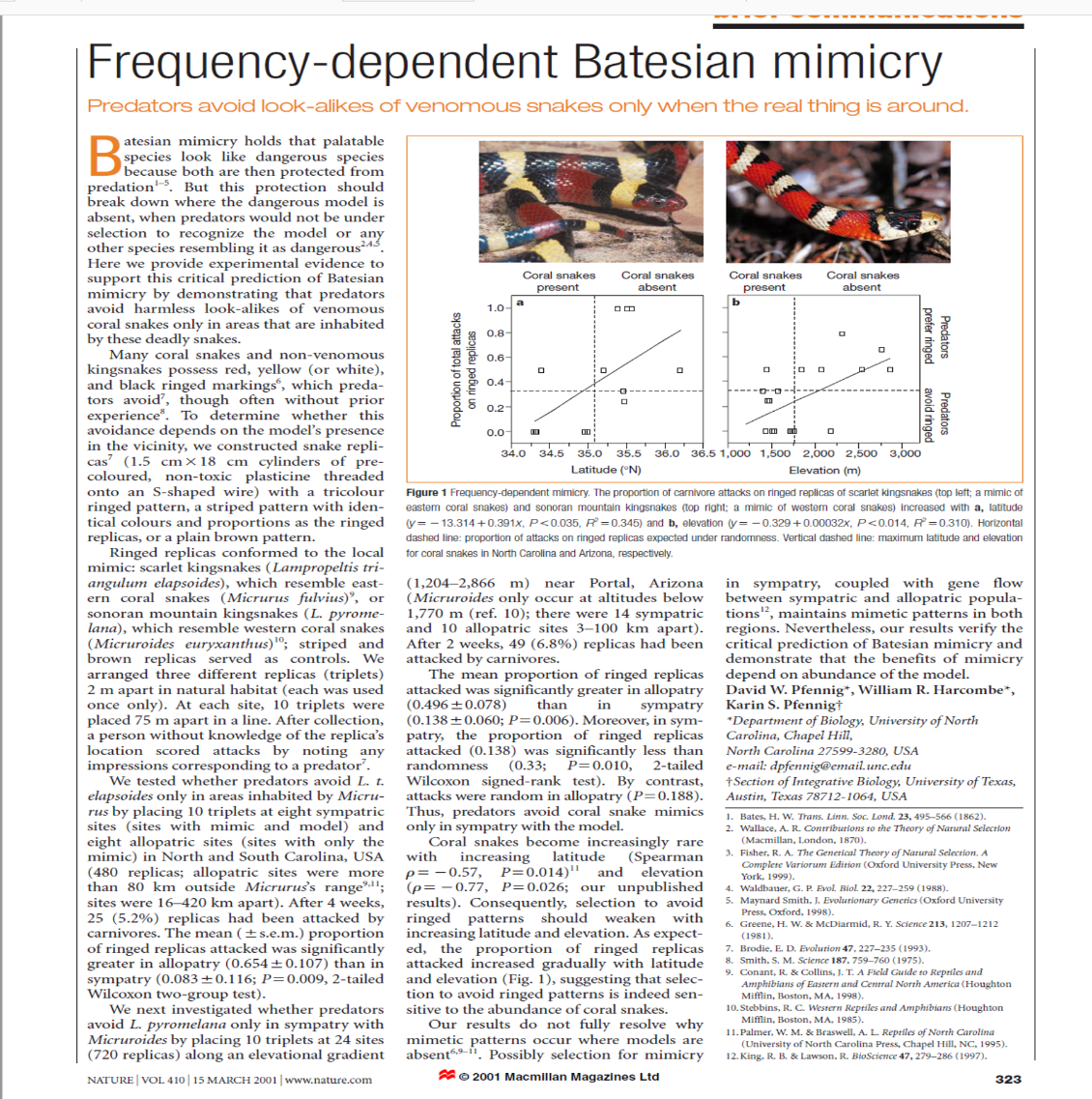
Assignment Directions: Read the article below on Batesian mimicry. See the list of terms to I.D. while you read. DO NOT DEFINE THESE TERMS, unless you are unfamiliar. For example - you want to start by identifying what the INITIAL OBSERVATION is from the actual experiment.  This assignment is to be completed in your science notebook (title the page: Batesian Mimicry - 1.1 assignment).

Your preparation for this will allow you to complete the assignment for IN CLASS next week! 

FAQ: What should I record for statistical analysis??
A: Simply record the different tests that were used and the values next to those tests. You do not need to know what these figures mean yet. 

- HIGHLY RECOMMENDED tip: Diagram! Anytime you are trying to visualize a experimental set-up, it's much easier to do so if you sketch what the set up would look like. 

- PDF Version: Print at School or at Home!

Article - Batesian Mimicry.pdf Article - Batesian Mimicry.pdf
Size : 131.508 Kb
Type : pdf

While reading I.D. the following:

  1. initial observation
  2. problem/question
  3. hypothesis
  4. independent variable
  5. dependent variable
  6. control group(s)
  7. experimental group(s)
  8. constants
  9. qualitative data
  10. quantitative data
  11. statistical analysis
  12. conclusion

QUIZ

Will be assigned as homework on ____, DUE ____ Record the same 12 items from above. We will have a progress check over this article in class on Thursday. 

Article - Contagious Chimpanzee Yawning.pdf Article - Contagious Chimpanzee Yawning.pdf
Size : 286.572 Kb
Type : pdf